
Out of Stock
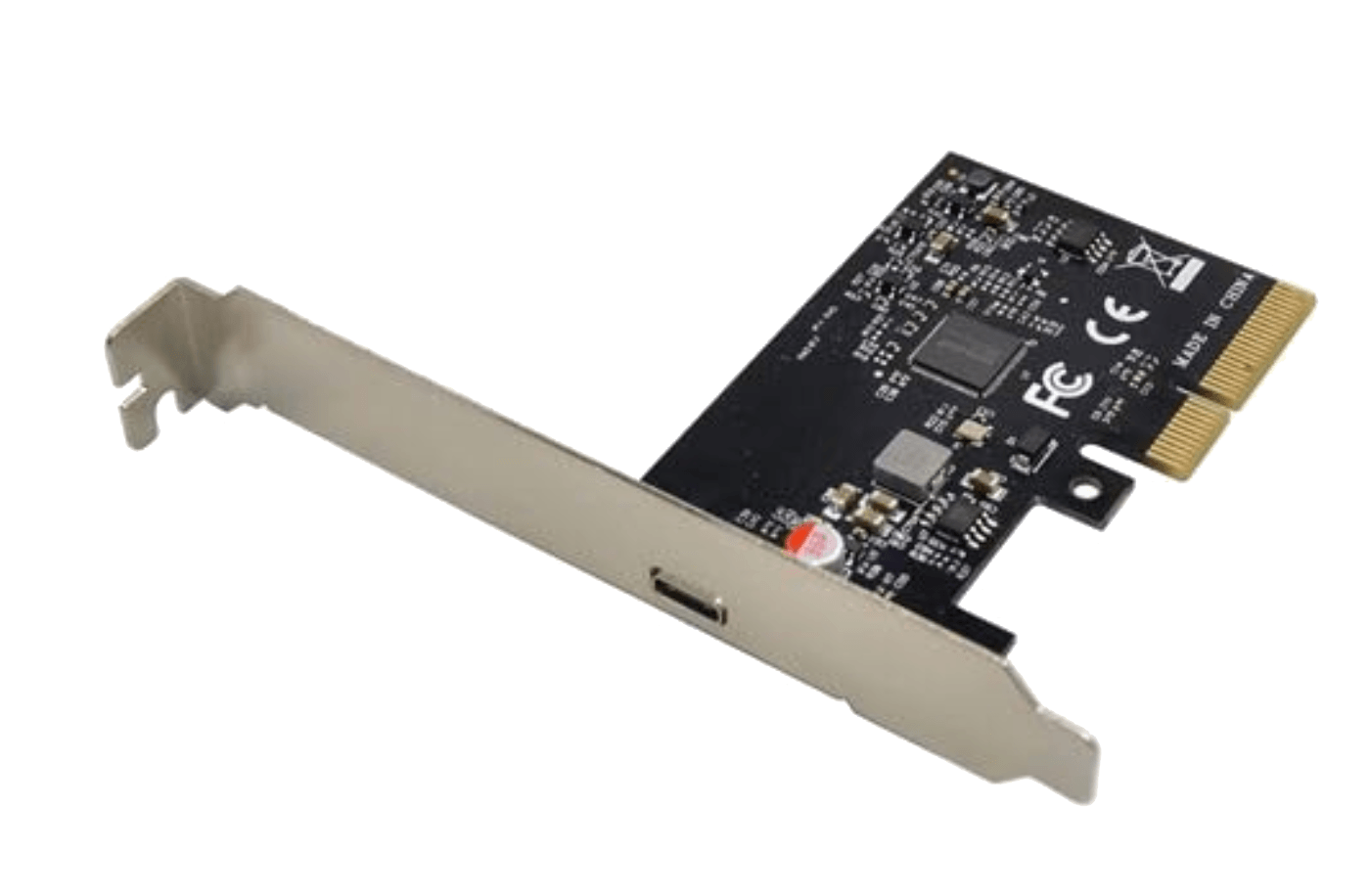
The ProLab 1 Port USB 3.2 20Gbps Type-C Port Expansion Card is a high-speed PCI Express USB connectivity solution designed for enterprise workstations, professional storage systems, industrial computing platforms, and data-intensive environments requiring next-generation USB bandwidth. Engineered around the USB 3.2 SuperSpeed+ architecture, the card enables systems to integrate ultra-high-speed USB Type-C connectivity through a PCIe Gen3 x4 interface while maintaining low-latency communication and stable throughput for demanding peripheral workloads. Supporting transfer rates up to 20Gbps, the adapter is particularly suited for professional external NVMe storage, high-capacity backup devices, media production systems, industrial acquisition hardware, and enterprise data transfer environments where sustained bandwidth and reliable device interoperability are essential.
The USB subsystem supports SuperSpeed+ USB 20Gbps and 10Gbps operation alongside SuperSpeed 5Gbps and Hi-Speed USB 480Mbps devices, enabling seamless integration within mixed-generation infrastructure environments. This backward compatibility allows enterprise systems to support both modern high-bandwidth peripherals and legacy USB devices through a single standardized Type-C interface. The 20Gbps transfer capability is particularly advantageous for workloads involving external NVMe SSD enclosures, large-scale backup operations, high-resolution video editing, enterprise content migration, virtualization storage access, and professional media ingestion environments where very high sequential transfer performance is required.
Support for USB Attached SCSI Protocol (UASP) enhances storage efficiency by reducing communication overhead and improving command queue handling for compatible devices. In real-world enterprise storage environments, this results in improved transfer consistency, lower latency, and more efficient sustained throughput during intensive data transfer operations. The controller architecture also supports multiple transfer types including Control, Bulk, Stream, Interrupt, and Isochronous transfers, allowing compatibility with a broad range of professional USB devices including storage systems, industrial instrumentation, audio-video interfaces, acquisition hardware, and specialized enterprise peripherals.
Additional controller-level features further improve deployment flexibility and operational stability. Support for USB 3.2 and USB 2.0 link power management enables more efficient power utilization within enterprise and industrial systems while maintaining device responsiveness during active workloads. Independent port power control enhances stability by enabling more granular management of connected devices, while integrated overcurrent detection mechanisms help protect both the host platform and connected peripherals from abnormal electrical conditions. Remote wake and wake event functionality support managed power-state operation and remote activation scenarios commonly required within enterprise workstation and industrial computing environments.
The adapter utilizes a self-powered design and does not require additional SATA or auxiliary power connectors, simplifying deployment within workstation, rackmount, and industrial chassis configurations. Despite the simplified power architecture, the USB Type-C port supports bus-powered operation up to 5V/3A, enabling reliable connectivity for high-performance portable SSDs, enterprise docking solutions, acquisition devices, and other power-demanding USB Type-C peripherals. This streamlined installation design reduces internal cable complexity while maintaining stable device power delivery for professional usage scenarios.
From a deployment perspective, the card includes a pre-installed full-height bracket for standard workstation and server installations, while an additional low-profile bracket is included for compact systems and space-constrained chassis environments. The PCIe board dimensions of 128 mm x 110 mm enable compatibility with a broad range of workstation towers, industrial systems, embedded platforms, and enterprise rackmount infrastructures supporting PCIe expansion cards. This flexibility allows the adapter to integrate effectively into professional storage systems, industrial computing environments, edge deployments, and compact workstation platforms.
Broad operating system compatibility enables deployment across modern enterprise and professional computing infrastructures. The adapter supports Windows 8, Windows 8.1, Windows 10, Windows 11, and Windows Server 2012 environments, while Linux compatibility extends to Linux kernel 2.6.31 and later with native operating system support for UASP functionality eliminating the need for additional driver installation in most Linux deployments. macOS compatibility includes support for macOS 10.8 through 10.12, although integrated macOS 10.11 drivers do not provide native USB 3.2 support. This broad compatibility enables integration into heterogeneous workstation, storage, and enterprise computing environments across multiple operating system platforms.
The adapter is also designed for reliable operation within demanding environmental conditions commonly encountered in industrial and enterprise deployments. Operating temperature support ranging from 0°C to 85°C and storage tolerance between -25°C and 85°C allow dependable operation within thermally intensive workstation and server environments. Humidity tolerance from 15% to 90% RH further supports deployment flexibility across varied infrastructure conditions. Compliance with CE, FCC, and RoHS certifications confirms adherence to internationally recognized standards for electromagnetic compatibility, environmental compliance, and enterprise integration requirements.
Overall, the ProLab 1 Port USB 3.2 20Gbps Type-C Port Expansion Card provides a professionally engineered high-speed USB connectivity platform for enterprise systems requiring ultra-high-bandwidth Type-C expansion, low-latency storage communication, and dependable long-term operational stability. Its PCIe Gen3 x4 architecture, ASMedia ASM3242 controller platform, USB 3.2 20Gbps capability, UASP support, and broad operating system compatibility make it well suited for enterprise storage infrastructures, professional workstation deployments, industrial computing systems, and high-performance data transfer environments where reliable next-generation USB connectivity is essential.