
Out of Stock
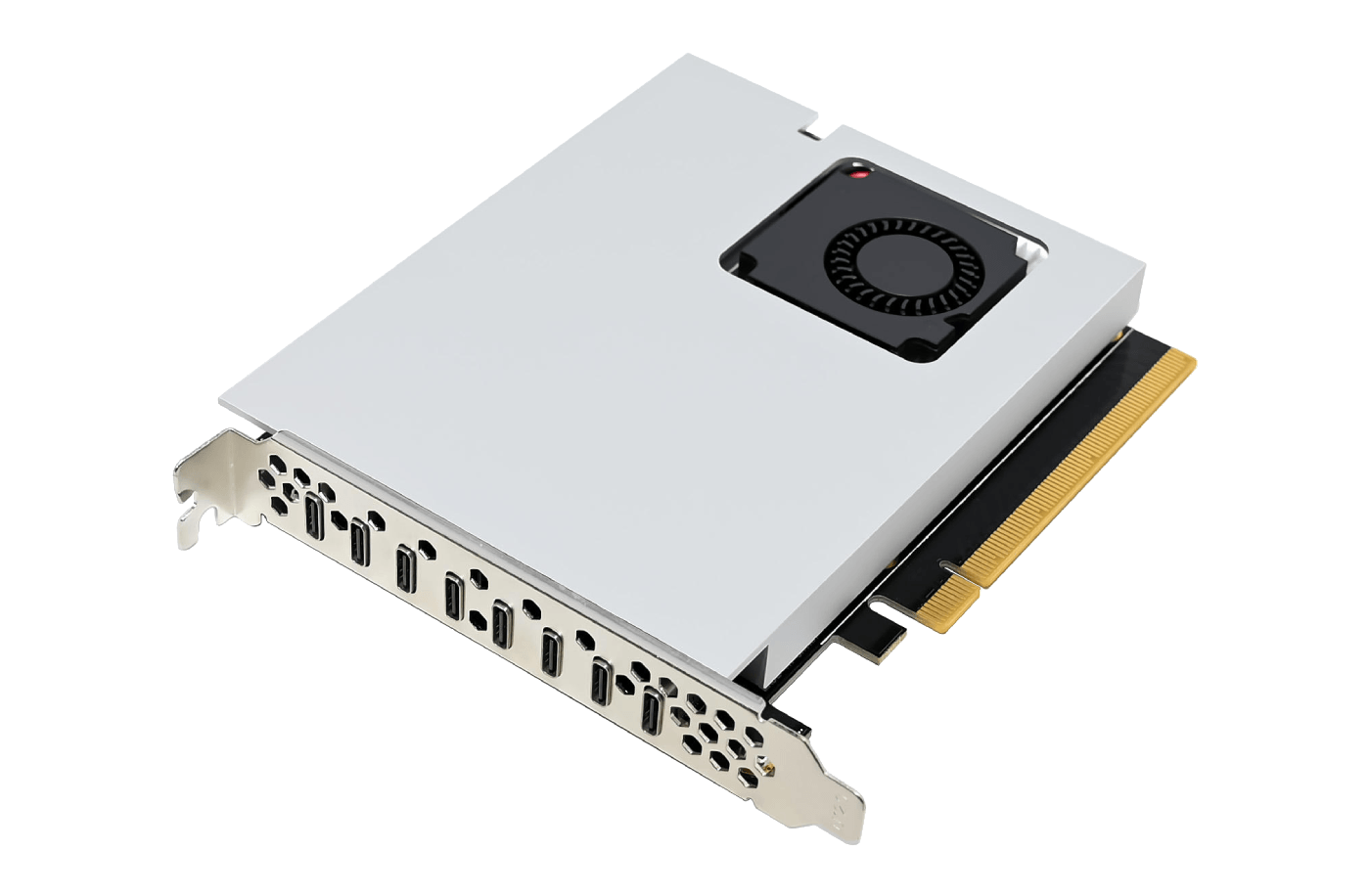
The ProLab 8 Port USB 3.2 20Gbps Type-C Port Expansion Card is a high-density PCI Express USB expansion platform engineered for enterprise workstations, virtualization hosts, industrial systems, storage infrastructures, and professional computing environments requiring large-scale ultra-high-speed USB Type-C connectivity. Designed for deployments involving multiple bandwidth-intensive peripherals operating simultaneously, the adapter enables systems to integrate eight USB 3.2 Gen2x2 Type-C interfaces through a PCIe Gen3 x16 architecture while maintaining stable throughput, efficient bandwidth distribution, and low-latency communication across connected devices. Supporting transfer speeds up to 20Gbps per port, the card is particularly suited for enterprise backup infrastructures, external NVMe storage arrays, professional media production systems, virtualization storage platforms, industrial acquisition hardware, and large-scale data processing environments where sustained high-bandwidth USB communication is critical.
The adapter utilizes the ASMedia ASM3242 USB 3.2 host controller in combination with the Broadcom PEX8749 PCI Express switch architecture to provide scalable PCIe lane management and optimized multi-device bandwidth allocation. Operating over a PCI Express Gen3 x16 interface with 8GT/s signaling capability, the card delivers substantial upstream bandwidth resources capable of supporting concurrent high-speed USB workloads without introducing significant bus-level congestion. This architecture is particularly beneficial in enterprise and workstation environments where multiple external SSD enclosures, removable storage systems, acquisition devices, or high-throughput USB peripherals may remain active continuously under sustained transfer workloads.
Compliance with Universal Serial Bus 3.2 specifications and Intel eXtensible Host Controller Interface (xHCI) standards ensures compatibility with modern enterprise operating systems and standardized USB controller management frameworks. Support for USB Attached SCSI Protocol (UASP) improves communication efficiency between the host system and compatible storage devices by reducing protocol overhead and optimizing command queue handling. In enterprise storage and professional workstation deployments, UASP support contributes to lower latency, improved transfer consistency, and enhanced sustained throughput during workloads such as large-scale backup processing, virtualization storage access, enterprise content migration, high-resolution media editing, and external NVMe-based caching or archival operations.
The USB subsystem supports SuperSpeed+ USB 20Gbps operation while maintaining backward compatibility with SuperSpeed 10Gbps and 5Gbps devices as well as Hi-Speed USB 480Mbps peripherals. Compatibility with USB 3.2 Gen2x2, USB 3.2 Gen2, USB 3.2 Gen1, and USB 2.0 devices enables seamless deployment within mixed-generation enterprise infrastructures where legacy peripherals and modern Type-C devices must coexist within the same operational environment. This broad compatibility makes the adapter suitable for enterprise infrastructure modernization projects, engineering environments, industrial computing systems, and professional workstation deployments where interoperability across multiple USB generations is essential.
Enterprise-focused operational features further improve deployment flexibility and long-term reliability. Hot-swapping functionality allows devices to be connected or disconnected without requiring system shutdown, reducing operational interruptions and simplifying maintenance within production environments. Integrated overcurrent protection mechanisms provide hardware-level protection for both the host platform and connected peripherals, improving operational stability during continuous workloads and dense peripheral deployment scenarios involving multiple bus-powered devices.
To support stable operation of high-performance USB Type-C peripherals, the adapter incorporates a built-in ATX 6-pin auxiliary power connector that receives supplemental power directly from the system power supply. This dedicated power architecture reduces dependency on motherboard PCIe slot power allocation and improves current stability during sustained high-load operation. Each USB Type-C port supports up to 5V/1.5A power delivery, enabling reliable operation of portable NVMe enclosures, enterprise docking devices, acquisition hardware, professional USB peripherals, and removable storage systems commonly used in enterprise and industrial environments. The dedicated auxiliary power design is particularly important in dense multi-device deployments where consistent peripheral stability is required during extended operational periods.
The adapter is also optimized for virtualization and enterprise infrastructure integration. VMware ESXi compatibility allows deployment within virtualized environments where USB passthrough functionality is required for enterprise storage systems, industrial interface devices, hardware licensing solutions, or specialized peripheral communication. Broad operating system support includes Windows 8, Windows 8.1, Windows 10, Windows 11, and Windows Server 2008, 2012, 2016, and 2022 platforms, enabling compatibility across both modern and legacy enterprise infrastructures. Linux support extends to Linux kernel version 2.6.31 and later, with native operating system support for UASP functionality eliminating the need for additional driver installation in most Linux-based enterprise environments. Compatibility with macOS environments from version 10.8 onward further supports deployment within professional content creation, engineering, and mixed-platform workstation infrastructures, although macOS 10.11 integrated drivers do not provide native USB 3.2 functionality.
From a physical deployment perspective, the adapter features a full-height bracket configuration and a PCIe board layout measuring 128 mm x 110 mm, allowing integration into standard workstation towers, enterprise rackmount systems, industrial chassis, and professional server platforms supporting full-height PCIe expansion cards. The dense eight-port Type-C configuration enables substantial USB expansion while preserving efficient PCIe slot utilization within systems where expansion resources may be limited.
The card is engineered for reliable operation within demanding enterprise and industrial deployment conditions. Operating temperature support ranging from 0°C to 85°C and storage tolerance between -25°C and 85°C allow dependable functionality within thermally intensive workstation and server environments. Humidity tolerance from 15% to 90% RH further supports deployment flexibility across varied infrastructure conditions. Compliance with CE, FCC, and RoHS certifications confirms adherence to internationally recognized standards for electromagnetic compatibility, environmental safety, and enterprise integration requirements.
Overall, the ProLab 8 Port USB 3.2 20Gbps Type-C Port Expansion Card provides a scalable and professionally engineered USB connectivity platform for enterprise systems requiring high-density ultra-high-speed Type-C expansion, virtualization compatibility, stable multi-device operation, and sustained high-bandwidth performance. Its PCIe Gen3 x16 architecture, ASM3242 and PEX8749 controller platform, USB 3.2 20Gbps capability, UASP support, dedicated ATX-assisted power delivery, and broad operating system compatibility make it well suited for enterprise storage infrastructures, professional workstation deployments, industrial computing systems, virtualization environments, and high-performance data transfer applications where dependable next-generation USB connectivity is essential.